
Dissolving Illusions
— Transitioning from an Extractive to a Value-Based Economy

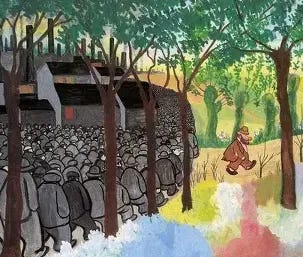
Image: “Back to Nature” (1945), Storm P (Robert Storm Petersen), 1882 –1949. Used for commentary.
Anna Thalena Iversen
Our Blinkered Vision
When we look back over the past couple of generations, it is easy to believe we have made remarkable progress. Our lives appear more comfortable, technology is more advanced, and opportunities seem more abundant than they were for our grandparents. Yet this truncated view deceives us. By measuring ourselves only against the recent past, we come to accept a very narrow horizon of what is possible. We mistake incremental improvements for real advancement, and we grow accustomed to the belief that “this is as good as it gets”.
What we fail to see is the truly extractive nature of our present system, because it is built on debt. Every unit of currency is issued as a liability, bearing interest. Yet the interest itself due over time is never created alongside the principal. This means that from the outset, there is always more debt owed (principal plus interest) than money in circulation to repay it. The gap can only be filled by issuing more debt — a treadmill that guarantees scarcity, fuels inflation, and keeps individuals, businesses, and governments perpetually chasing an ever-receding horizon.
In our everyday reality this translates to wages never keeping up with prices, savings being eroded over time and innovation being stifled because long-term vision is sacrificed to short-term debt service. This systemic deficit creates the rat race, forcing us to compete for our existence.
This design affects all our decisions. Because interest isn’t issued alongside the principal, households and firms must either cut real investment or take on new loans just to stand still. Prices creep up, wages lag, and savings decay. The “growth” we celebrate is often tomorrow’s income pulled into today — a hollow game that rewards those closest to credit creation at the expense of everyone else. This is why the rat race feels structural: it is.
This inflationary economy amplifies our despondent outlook, conditioning us to think that we no longer can afford novel, innovative solutions which would allow our society to make giant leaps forward. Half-hearted maintenance of existing infrastructure is perceived as good enough, severely stunting our expectations.
A quiet resignation seeps into our culture. Many of us have learned not to expect too much, not to imagine too freely, not to believe we deserve — let alone be capable of — creating a better world. We study and train to live as good a life as we can, but our choices are often led by what financially makes sense, not what our heart is telling us. As a result, visions of a radically different future are often dismissed as utopian fantasies. The idea of living in a world where abundance is attainable for anyone seeking it, trusting our creative inspiration to be our lifeline, sounds like frivolous poetry, not reality. Our imagination has been trained to stay within the boundaries framed by the constructs of our society and by reference to recent history.
What if the very structures we take for granted — the way we measure progress, organize economies, or finance innovation — are themselves creating the bars of a cage which we have become so accustomed to, making it difficult for us to see beyond it? What if the supposed “limits” of what humanity can achieve are not natural limits at all, but constructs we have been conditioned to accept?
The Chicken Coop Analogy
In a recent article and subsequent conversation, author and analyst Alex Krainer[1] offered a simple yet engaging analogy. He observed that most commentators and policymakers, when contemplating the state of our world, are preoccupied with making the chicken coop more comfortable. They fervently debate how to increase the size of the roosts, improve the feed, the lighting, or the length of “lights out” during the night. Their vision, however, rarely extends beyond the coop itself.
What almost no one dares to imagine is life outside the coop — what Krainer calls “God’s Green Earth”. Out there, the horizon is open, the possibilities abundant, and the constraints of the cage simply vanish. Yet when such possibilities are mentioned, they are often dismissed as naïve or utopian. After all, if one has lived all one’s life in the coop, the thought of venturing into the open field seems almost unthinkable. To some, a life outside the coop cannot even be conceived of as a possibility. The coop has truly become Plato’s cave.
Krainer’s analogy captures a central problem of our time: we confuse reform with transformation. We endlessly tinker with the existing system: shifting regulations, adjusting incentives, reshuffling leadership, but we rarely ask whether the system itself is the problem. In doing so, we bind ourselves to a life that may be tolerable, but never one where we can discover our full potential and be truly free.
Why We Struggle to See Beyond the Coop
If life outside the coop promises freedom and abundance, why do so few of us imagine it — let alone walk toward it? Part of the answer lies in the way human perception is shaped. We normalize what surrounds us. When our lives, our news, and our institutions all operate within the same boundaries, those boundaries begin to feel like natural law, as though there is no other way. The coop becomes invisible, and its constraints begin to masquerade as reality itself.
There is also the subtle weight of history. Generational memory is short. Most of us only compare our lives to those of our parents or grandparents, and so we believe that we are advancing. We see small gains in comfort or technology as proof of progress, even if the deeper structures of scarcity and control remain unchanged. The cage has been refurbished and repainted, but it is still a cage.
Add to this the reinforcing systems of politics, finance, and media, and the coop becomes almost self-policing. Narratives are shaped to tell us that alternatives are impractical, dangerous, or simply not possible. Economic commentary focuses on quarterly cycles and marginal reforms, rarely questioning the framework itself. And so our collective imagination is kept domesticated, like animals on a farm.
Finally, there is the simple human fear of change. However cramped or unsatisfying the coop may be, it is familiar. Stepping outside means uncertainty, and uncertainty often feels more frightening than constraint. It is safer, or so we tell ourselves, to endure life as it is than to risk venturing into the unknown.
And so, the open fields of possibility — God’s Green Earth — are dismissed as utopian, while the coop, with all its limitations, is mistaken for the full scope of reality.
Seeds of God’s Green Earth — Value-Based Thinking
Even within the coop, seeds of another reality are beginning to sprout. Increasingly, people are questioning whether the economic and financial structures we inherited are truly aligned with human creativity, innovation, and wellbeing. Many have begun to sense that value is not the same as price, and that speculation masquerading as wealth creation leaves most people poorer in spirit, if not in fact.
In a recent discussion on the Bitcoin Satoshi Vision (BSV) blockchain[2], builders and thinkers explored what a value-based economy could look like. The conversation was not about how to make current markets more efficient, but about reimagining the foundations.
The BSV blockchain provides a practical ramp out of the extractive economy and into a value-based one. Unlike speculative crypto tokens or financial abstractions, Bitcoin’s original design, as laid out by Satoshi Nakamoto in the 31 October 2008 Bitcoin white paper[3], allows digital outputs be structured, timestamped, and exchanged at scale — giving digital data provenance, scarcity, and ownership. Raw data remains abundant, whereas registered outputs become lawful, tradable commoditised assets.
This means that creativity, innovation, and productive work can be directly monetised without passing through layers of intermediaries. Micropayments as small as fractions of a cent can move near-instantly across the globe, enabling revenue to be shared fairly between creators, contributors, and participants. In this way, BSV is not proposing a speculative casino economy but a utility infrastructure: it makes it possible to reward value in real time, transparently and at massive scale. This simple but profound shift dissolves the extractive logic of speculation and re-aligns finance with creative endeavours:
Value is not speculation: it arises from creativity, service, and real contributions to our community, and to life on Earth.
Innovation need not be extracted from: it can be nurtured and rewarded directly and the innovators and their supporters can all gain from working in consort.
Revenue can be shared lawfully and transparently: no longer captured by a small class of intermediaries.
Technology can serve as a bridge: enabling direct exchange, trust, and accountability at global scale.
These conversations sketch a new outlook for organising society — where human creativity and real value are the driving forces — enabling us to catch a glimpse of “God’s Green Earth” as a concrete possibility. They reveal that when people dare to step beyond the familiar logic of the coop, new systems of value begin to take shape.
The question is no longer whether a different paradigm can exist, but how we choose to build it.
A Bridge Beyond the Coop
If the coop represents the old order of debt, speculation, and scarcity, then what will carry us into the open fields of value, creativity, and abundance? Ideas alone are not enough — they need structures that can embody them, mechanisms that allow people to participate in the new reality without first having to dismantle the old one.
This is where new models of financing and exchange emerge as bridges. Instead of relying on stock markets that trade in abstractions, or financial instruments designed to extract rather than nurture, we are beginning to see frameworks that align investment directly with value creation. These models bypass speculation and instead channel returns from the actual flow of innovation, creativity, and productive work.
In such a system, the old image of the investor as a gambler on price fluctuations begins to dissolve. Participation becomes about sharing in value, not betting on outcomes. The creator or innovator is no longer forced to surrender their vision to extractive capital; instead, they can invite support from those who believe in the work itself, with the assurance that gains will be shared lawfully and transparently.
This bridge isn’t fanciful — it is already being built. It represents a quiet but profound shift: from ownership to partnership, from speculation to contribution, from scarcity to shared prosperity, from dependency to sovereignty. It is one of the ways humanity is beginning to step beyond the coop and rediscover the wider landscape of possibility.
A Future Beyond Utopianism
Every groundbreaking change in history has followed a familiar pattern. At first, it is dismissed as unrealistic, too idealistic to work in the “real world.” Then, as pioneers begin to build and test it, the idea is ridiculed or resisted. Only when it is finally lived and experienced by the many does it shift from unthinkable to obvious.
So it will be with the transition from the coop to God’s Green Earth. For now, many will continue to believe that small reforms are the best we can hope for. They will cling to the comfort of what they know, unable to see beyond the walls that enclose them. But as new structures for value and exchange take root, and people experience firsthand what it means to participate in an economy where creativity and contribution are rewarded directly, the picture will change.
Quantum physics and complexity science reminds us that systems don’t only change linearly; they undergo phase transitions. Long-gathering potential suddenly crosses a threshold and the system reorganises — not step by step, but in leaps. What looks impossible from within one frame of reference can, from another, become inevitable. Social systems behave similarly: when coherent tools, shared narratives, and lived incentives align, change looks instantaneous from the outside. That’s why “God’s Green Earth” is not idealistic fantasy. The groundwork is already being laid, in technology, in human imagination, and in our growing dissatisfaction with the coop. When conditions align, the shift can come faster than most dare dream of.
What today seems utopian will tomorrow be recognized as simply natural. Abundance will no longer be an abstract dream but a lived reality. And once people taste it, they will wonder why they ever settled for less.
Reclaiming God’s Green Earth
The coop was never meant to be our destination. It was a holding pen — a stage in humanity’s development that offered a measure of order, but also imposed severe limits on what we could imagine and achieve. For too long, we have mistaken the walls of that coop for the horizon itself, convincing ourselves that this is as good as it gets, believing that life inevitably needs to resemble a game like Monopoly — where winners require losers.
But the open fields have always been there, waiting. “God’s Green Earth” is the natural state of life when artificial constraints are lifted. It is the place where value is recognized in its true form — in creativity, in service, in the flourishing of people and communities.
The choice before us is simple, though not always easy: remain in the safety of the coop, or take the step into freedom. For many, the benefits will not be visible until they are experienced. But once we begin to live in systems that reflect value rather than speculation, abundance rather than scarcity, the old world will lose its hold on our imagination. When we experience this shift and we understand that survival does not depend on competition, peace becomes attainable.
The coop will be remembered not as our home, but as the cage we once mistook for it. And God’s Green Earth — open, fertile, and vast — will no longer be a dream. It will be the ground beneath our feet.
About the Author: Anna Thalena Iversen is a former City of London financial services lawyer who now designs value-aligned finance. Anna has spent more than 20 years as a financial services lawyer in the City of London, having worked for financial institutions, law firms and consultancy firms, but left the profession in 2016 after the passing of her parents to cancer. This spurred her to embark on a new career in the health and wellbeing space where she became involved in a number of start-up and scale-up business ventures using novel, unique protocols and technologies. Since leaving her first career in finance, Anna has committed herself to re-imagining how the world of financial services could evolve to become aligned with human creativity, generating abundance rather than acting as its impediment — forcing humanity to focus on survival instead of thriving. There is clearly more in store for humanity than what we have seen and experienced, and Anna has devoted her time and energy into projects supporting these endeavours, in the knowledge that the pen is always mightier than the sword.
[1] Thank you Alex Krainer for providing the spark, giving rise to this article.

[2] Please refer to my earlier articles for a more detailed description of the Bitcoin Satoshi Vision (BSV) blockchain Anna Iversen | Substack
[3] “Bitcoin: A Peer-to-Peer Electronic Cash System” by Satoshi Nakamoto, 31 October 2008 bitcoin.pdf
More and more people are running toward crypto these days.
Some because of the motive itself, others because they hear things in the community. Many truly believe they’ve finally seen 'outside the coop'.
But the dilemma, they’ve caught a glimpse… crypto in its current form is no escape. It’s simply another elites' vehicle.
Under the old kings, queens, emperors, charging interest on lending was forbidden if I heard correctly. Today it’s celebrated as finance.
Back to the Future (flight skateboard), Odyssey (interstellar journeys) never arrived. Not because imagination was wrong, but because something kept blocking the path.
The 'honest blockchain' should facilitate the next level of humanity. I like the way you describe about BSV Blockchain.
The chicken coop is a great analogy. I don’t fully understand how currency and the financial system is all built on debt and how that will change. I do recognise the paradigm shift needed to change to rewarding value and moving to abundance instead of scarcity. I’m sure I’ll learn more as you write and hoping that you continue to.